Violence everywhere. Can we stop it?
The Reflejo Court offers one way to mend the broken.
These days have shaken me. Deeply. It is impossible to absorb the brutal videos from Minneapolis and elsewhere where ICE agents are abusing innocent people and manifesting a frightening police state. Obviously we need to stop the cruel policies of this administration. But also I wonder — if and when the violence subsides — how will our nation heal? How will those police state enforcers cope with the horror they inflicted on us? Will they be brought to justice by a community that seeks reconciliation or punishment? Will they be able to return to a home and a community — or will we have to keep them behind bars for our safety?
If you’re broken, can you heal? Can others trust you?
Violence is unfortunately pervasive in our culture, but there is a microcosm of compassionate professionals who are breaking the cycle of violence, one person at a time.
Last Friday, we spent the day in the Bexar County Court 13 watching the Reflejo Court provide pretrial options for first time offenders. Judge Rosie Speedlin-Gonzalez (hugging the support dog Hairy in front) shepherds a team of professionals including attorneys, law enforcement, health care and counseling.
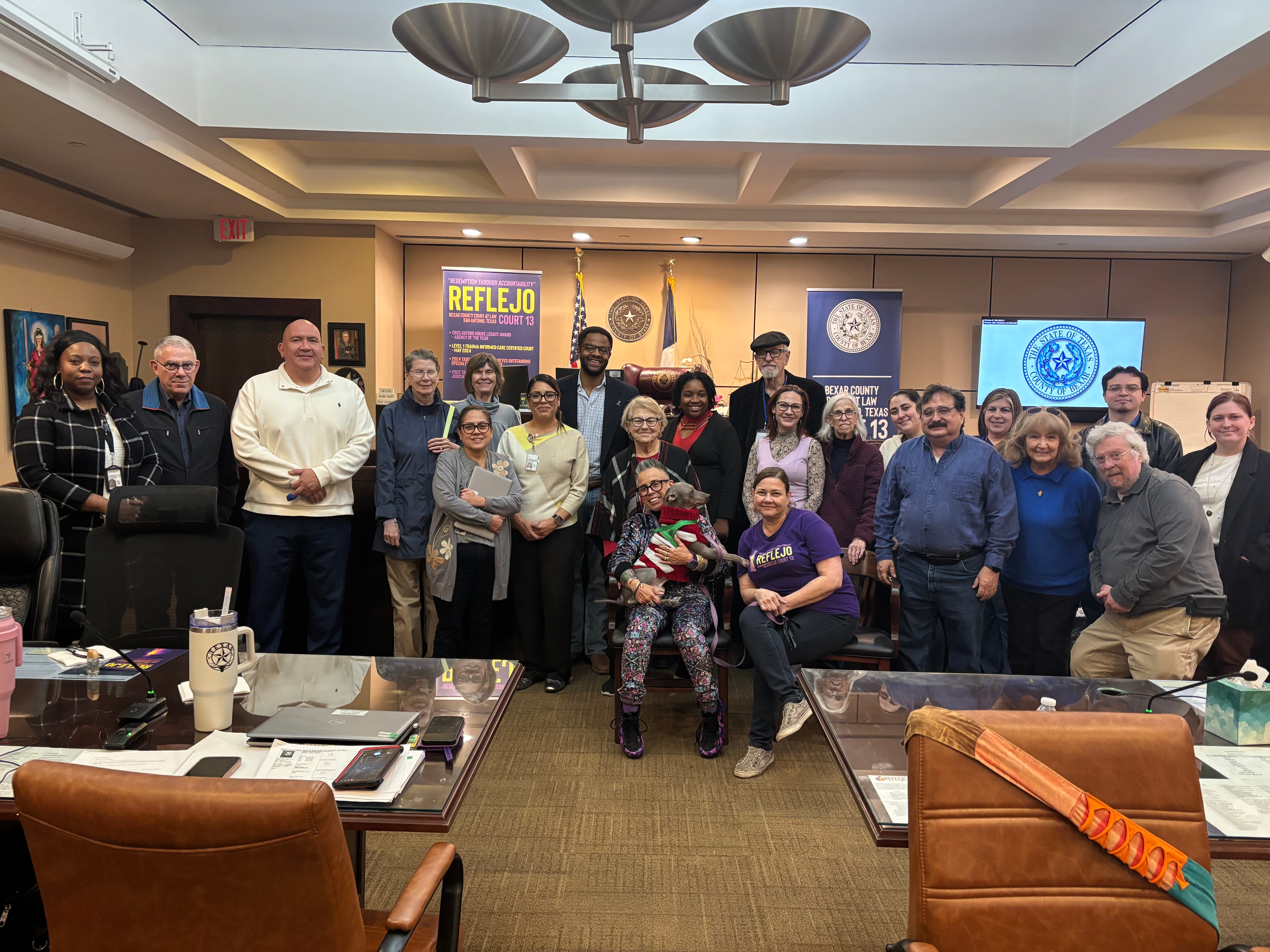
The Reflejo Court has received much national attention and won numerous awards for targeting “the domestic violence offender with the intent to reduce recidivism among this population through intense supervision by multi-disciplinary team that includes a prosecutor, public defender, coordinator, case manager, treatment provider, law enforcement.”
During the morning presentation we met the team, and watched a video describing the program with testimonies from program graduates who had completed a year of support.
Then the team worked together around the tables with their laptops, talking through the progress of each individual. We listened to excruciating baby steps of accountability and reinforcement. The team dealt with how to address someone missing curfew call-ins or another who cut off her ankle monitor. Is the next step encouragement or tough love? Here were so many people taking so much time to help 17 people change their lives.
Obviously this approach takes money. I wonder: isn’t it more expensive to lock up first offenders, thereby increasing their families’ heartache while decreasing the odds that these people will become productive members of society in the future?
The program participants still live in the real world, and hopefully their life changes will help those in the circles around them heal as well.
I left the field trip thinking that the Reflejo model merits our support. Step by step, I’m hoping our society can incorporate this approach beyond San Antonio, and help us, as a nation, find a path to peace.
"Isn’t it more expensive to lock up first offenders?" This seems like a question with a quantifiable answer. I don't know the answer, but when I read about for profit prisons, I assume someone is keeping that profit.